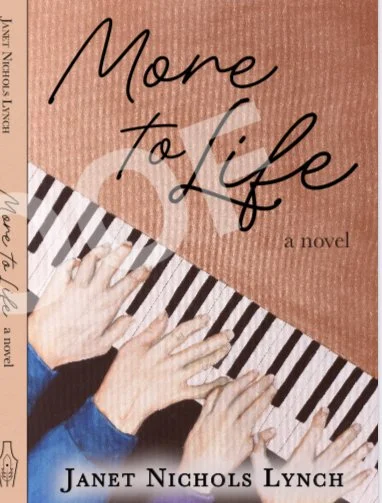
Retired school teacher Colette Corbyn goes kicking and screaming into assisted living, when she has planned to live out her days in the privacy of her own home. As she begrudgingly settles into Shady Meadow, she makes an unlikely friend, Margaret, who claims the Women’s Movement demeaned women. A loud, obnoxious neighbor, Dottie, seems to be off her rocker, but she’s actually addicted to opioids and has an alarming secret life. Best-selling novelist Susan Hartley, afflicted with Alzheimer’s, doesn’t recognize her latest book, and becomes violent when she mistakes Colette for her sister.
Colette struggles to come to terms with her sometimes contentious daughter Brooke and seeks a relationship with her grandson Carter, long lost down the rabbit hole of QAnon. Colette thinks she is done with romance until she meets Harry, who suffers from AMD and can only read music through a magnifying glass. As Colette and Harry share their love of piano playing, Colette discovers complications in his life which may prevent their relationship from enduring. With compassion and wit, Lynch demonstrates that old age has its perks, and, nearing the end, every day is worth living to its fullest.

It’s 1913 in Oakland, California, and eight-year-old Ellen Jackson has white classmates who bully her and a teacher who believes Black children can’t learn. Ellen’s mother decides to move the family to Allensworth, the only town in California where Blacks own their own property and govern themselves.
Oakland is a bustling city with in-door plumbing and gas while in rural Allensworth, Ellen has to lug water from a community well and use the backyard outhouse. But the community members are so helpful and friendly that nobody locks their doors. Ellen’s new teacher, Professor William Payne, holds high expectations for his students, and when Ellen falls behind in reading, her tutor is none other than the esteemed Colonel Allensworth.
Ellen comes to love Allensworth so much that she wants to make it her forever home, but trouble is brewing in the little town, and its courageous citizens are uncertain they can hold on to their dream come true.
A little girl from Oklahoma dared to dream big. Young Betsy Herring was an energetic tomboy and such a whizz in school, her second-grade teacher looked her in the eyes and said, “When you grow up, if you really want to, you can do something.”
Elizabeth Warren won a debate scholarship to Georgetown University, became a professor at Harvard Law School, and worked to reform Wall Street to save middle class families from bankruptcy. She went on to became the first female senator from Massachusetts and a presidential candidate with a plan for everything. What does it take to run for president? Fame, money, hard work, but most of all, a willingness to fight for what you believe in.


Florence Price's was the first African American female composer to have a symphony performed by a major orchestra in the US. In fact, she composed over 300 compositions. Born in Little Rock in 1887, Florence was only three when she began piano lessons with her mother. By age 18, she had earned two degrees from the New England Conservatory of Music. To pursue her career as a composer, Florence faced a daunting battle on three fronts: she was an American, she was a woman, and she was Black. By combining elements of Classical music with African American folk songs, dance rhythms, spirituals, and jazz, Florence Price’s music bursts onto the concert stage as truly American and uniquely her own.

Click cover to purchase on Amazon.
When Clara was just 19, her dad plotted to separate her from her boyfriend, Robert. He sent her away to distant Paris to arrange and perform her concerts all on her own. He expected her to fail, but Clara did just fine. In fact, she became the most famous female pianist of the nineteenth century, performing her own compositions. Eventually, she got to marry Robert, but only after taking her own father to court. Do you ever wonder why pianist play from memory? Clara was the first to do it. Read on. Clara will surprise you.

Click cover to purchase on Amazon.